Showing posts with label books. Show all posts

Sunday, January 25, 2015

Ordinary ch. 11

The last chapter in ordinary is called "after ordinary: anticipating the revolution."
"The difficult but necessary location of Christian existence for now is that paradoxical era of the "already and not-yet." The Next Big Thing is not another Pentecost or another apostle or another political or social cause. It is Christ's return. In demanding an immediate satisfaction of our heart's longing, we replace this event with manufactured spectacles. Ironically, the most faithful Christian life is one that embraces a pilgrimage rather than a conquest. The ordinary life—sustainable discipleship and disciple-making—is the order of the day, as we live each moment in eager expectation of The Next Big Thing on God's schedule."
I've so enjoyed this book and the Lord has used it to bring much freedom and peace to my every day.  So as I wait for the day of the Lord I want "to aspire to live quietly, and to mind [my] own affairs, and to work with [my] hands" (1 Thes 4:11).

I'm also reminded of the truth for us as believers that, "to live is Christ, and to die is gain."

Saturday, January 24, 2015

Ordinary ch. 10

"stop dreaming and love your neighbor" is the title of chapter 10 in Michael Horton's book, ordinary.  
"From childhood we're told that we can be anything we want to be, do anything we want to do, make of ourselves whatever we dream. We often miss the trees for the forest, looking for ambition causes instead of actual people God has sent into our lives that moment, hour, day, or year. Meant to inspire us, this constant message can actually paralyze us with anxiety. This chapter focuses on the importance of staying at our posts to which God has called us: as children, parents, extended family, neighbors, coworkers, and citizens. We need to stop looking for extraordinary callings to give meaning to our lives, which often encourage us to think of others as tools in our self-crafting."
And I really appreciated his words on women.  He says, "we are ambivalent about the role of women—in the home, in the church, and in society. This tension gets transferred to children, especially girls."
"On the one hand, they're expected to be preparing for Proverbs 31 wifehood/motherhood.  That's pressure enough. But on the other hand, they're also encouraged on many hands to be everything a boy can be, to do everything boys can do. Schizophrenic ourselves on these questions, we may even place both of these contradictory and unlivable expectations on our girls."
He says we need to avoid legalism and antinomianism and get wisdom! What Horton challenges is the "particular stress of being 'superwoman.'"

"Nowhere is the ordinary more important to culture and yet less valuable in our society than in relation to motherhood. I'm not saying anything pro or con here about women working outside the home. I'm only suggesting that the burdens we place on women—even from childhood—make them anxious about life and drive them to expect dissatisfaction with the normal and everyday aspects of life that are so crucial for the development of deep roots, wisdom, and nurture for the whole family. Many of the things that mothers do in the home are not even measurable, much less stupendously satisfying on a daily basis. Much of it can be tedious, repetitive, and devoid of the intellectual stimulation found in adult company. In a myriad of ways, the daily calling of dying to self is felt more acutely by mothers.  What they need is fewer guilt trips and expectations and more encouragement as they invest in ordinary tasks that yield long-term dividends."

Thank you Mr. Horton!  This mothers heart needs this encouragement as I know my dear mother friends do as well!  

I also appreciate this wisdom:
"Our families, including us, do not need more quality time, but more quantity time. That's when most of the best things happen. We think that such events are spontaneous—and to a certain extent they are. But they are really the things that bubble up when people are living ordinary lives together."
Here is the good news:
"Now we live in a grace economy, not a debt economy. At last we are free to be thankful, to offer ourselves as "living sacrifices" of praise rather than dead sacrifices of guilt. We're on the receiving end of everything. We're not building a kingdom, but receiving one. We're not appeasing God, but receiving his gift of righteousness in his Son."
He ends the chapter talking about "the most taboo topic in our society"—death. "Wisdom calls us to use this fact as a trigger to reorient us to the things that really matter. As it turns out, they're the everyday things." 
"'So teach us to number our days that we may get a heart of wisdom' (Ps 90:12). When we do that, we shrink a little bit, but God and his world grow much larger. And whenever that happens, we are ready to make the most of the ordinary."

Friday, January 23, 2015

Ordinary ch. 9

In chapter 9, "God's ecosystem," Michael Horton starts out by giving a biblical overview of how God's Kingdom is like a garden.  Based on John 15:1-5 he states that, "now Jesus is the temple and he is the vine." 
"What are some of the common threads we can draw tother from Jesus' organic analogy of his kingdom?"
And he lists the following:
1. It is his kingdom. 
2. There is no personal relationship with Christ, the Vine, apart from his church, the branches.
3. The growth of this kingdom (and each member of it) is slow.
4. It takes a lot of work.

Great reminders to my soul as I'm tempted to live autonomously, independently, selfishly, and yet expect rapid and overnight spiritual growth!

I especially appreciated the latter section of this chapter in the section called "Emerging Branches." He discusses the question of children and fear people can have of "parent's 'interfering' with the child's personal relationship with Jesus" or "wondering whether we are abusing children by 'indoctrinating' them before they can choose a religion (or no religion" for themselves." Then Horton states, "The problem is that our children increasingly have not been given enough of the Christian faith even to apostatize from it properly." He then quotes several big name advertising companies and how they target children to get them to be lifetime consumers of their products.
"We dare not imagine that our children are neutral choosers any more than we are."
Horton shares findings from an interesting article in The Atlantic by Larry Alex Taunton on his survey of young atheists. The findings showed young people who seemed genuinely disappointed that they couldn't find answers to their big questions.
"The young atheists interviewed had attended church, but said that "the mission and message of their churches were vague." They "felt their churches offered superficial answers to life's difficult questions" "Serious-minded, they often concluded that church services were largely shallow, harmless, and ultimately irrelevant." 
He then discusses the question of children and youth ministry.
"Giving our attention again to "best practices" in spiritual gardening, our homes and churches need to become more child-friendly without being child-centerered. I share Ivy Beckwith's concern that "by prohibiting children from the worship of their faith community we are, in effect, prohibiting them from an important piece of their spiritual development and denying them the opportunity to learn how to worship God in the tradition of their community."
Here is the sad and sobering assessment…..
"Unintentionally, the net effect of youth ministry has been largely to alienate younger generations from the ordinary life and ministry of the church. Dean argues that in so radically shifting from traditional forms—such as including young people in the regular service, using a catechism to teach the basics, and reinforcing the faith at home—we have unwittingly undermined their faith."  
He gives great perspective on the reality that "we know, instinctively, that it's important for our children to acquire language and the ordinary rituals of their family environment in order to become mature." And Horton says, "I think that we are sometimes too worried about "imposing" our faith on our children." Yet, "Children are being catechized every day, but in what?" 

He rightly states that the church "should be the safest place for inquiring minds to discover the best answers to questions they will have into adulthood." And yet oftentimes "many parents and church leaders are in greatest danger of "imposing" their faith in these teen years in reaction against a question process that is mistaken for rebellion." Asking the hard questions is GOOD!

On this topic he concludes:
"The question is whether we are contributing to or detracting from the church's mission to build up each member into one body, in connection with its living Head."

Wednesday, January 21, 2015

Ordinary ch. 8

"we don't need another hero" is the title of chapter 8 in ordinary.  Michael Horton believes the "hero-thing has been overdone." He rightly states that we need a Savior…not more heroes!

He then talks about cultural transformation versus loving service and states that we need to reform our theology of culture. There is a lot he unpacks that was really good! I especially liked this summation though:
"But the kingdom of Christ advances directly by the Spirit's miraculous gathering of a people around the Lamb to the glory of the Father through the ordinary means of grace." 

I also love this point he makes:

"Loving actual neighbors through particular actions every day can be a lot more mundane as well as difficult than trying to transform culture." 

And this is the point, "if God's pleasure and glory are ultimate and our neighbor's good the penultimate goal, we will engage culture in the way that God has gifted, prepared, and called us to do." And, "the ideal of cultural transformation reflects a kind of collective ambition that overlooks ordinary faithfulness." 

And lastly….
"Even in society, we need ordinary neighbors who play their part in the story. We need fewer Christians who want to stand apart from their neighbors, doing something that will really display God's kingdom in all of its glory. We need more Christians who take their place alongside believing and unbelieving neighbors in the daily gift exchange. The thief is not expected to become a monk or a famous evangelist, but to "labor, doing honest work with his own hands, so that he may have something to share with anyone in need" (Eph 4:28)." 

Sunday, January 18, 2015

Ordinary ch. 7

Chapter 7 in ordinary is called "contentment." Michael Horton says, "The cure for selfish ambition and restless devotion to The Next Big Thing is contentment."
"In most cases, impatience with the ordinary is at the root of our restlessness and rootlessness. We're looking for something more to charge our lives with interest, meaning, and purpose. Instead of growing like a tree, we want to grow like a forest fire." 
This is so true! It's so easy to get "impatient with the ordinary" especially if we're not getting a lot of appreciation or seeing a lot of results in our ordinary (ahem....motherhood!). I want to be so content in Christ that I am content growing like a tree!
"If you're wondering whether your life counts if it consists of so many ordinary things every day, you are in good company. After all, God works through ordinary means every day in so many ways that we don't even notice his involvement and our complete dependence on him in each and every moment." 
"Once we recover a greater sense of God's ordinary vocation as the site of his faithfulness, we will begin to appreciate our own calling to love and serve others in his name in everyday ways that make a real difference in people's lives."
This is where I want to live....I want a greater sense of God's ordinary faithfulness! I want to appreciate my own calling to love and serve others in His name in everyday ways and trust that a difference in people's lives is happening!
"True contentment, therefore, comes first from resting in Christ." 

Friday, January 16, 2015

Ordinary ch. 6

Chapter 6 of Ordinary is called "practicing what we preach: no more super-apostles." Michael Horton drives home the point that we "desperately need more Timothys and a lot fewer would-be Pauls in the church."
"All of these models overlook the qualitative difference between the extraordinary ministry of the apostles and the ordinary ministry of those who followed them. There are no living prophets or apostles today - in Rome, in Texas, in California, or anywhere else. Their extraordinary ministry lad the foundation (1 Cor 3:10-11; Eph 2:20) on which the ordinary ministers build up the church (1 Cor 3:12-15; Eph 4:11-14)."
Horton also speaks about the danger of idolizing our leaders and that only Christ has a legacy.

I especially liked this section:
"But here is the good news: it is not your ministry, church, or people.  You do not have to create and protect a personal legacy, but simply to distribute and guard Christ's legacy entrusted to his apostles. You don't have to bind Satan and storm the gates of hell. Christ has already done this.  W're just sweeping in behind him to unlock the prison doors. You don't have to live the gospel, be the gospel, do the gospel, and lead the troops to redeem culture and reconcile the world to God. We are not building a kingdom that can be convulsed with violence like other realms, but we are "receiving a kingdom that cannot be shaken" (Heb 12:28, italics added)."
  "But we have this treasure in jars of clay, to show that the surpassing power belongs to God and not to us" (2 Cor 4:7.

Monday, January 12, 2015

Ordinary ch. 5

In chapter 5 of ordinary, "ambition: how a vice became a virtue," Michael Horton discusses how ambition has become something to be praised while biblically and historically it has been seen as a vice.

To be clear he says, "Our passion for life and achievement and our desire to strive toward a daring goal are essentially hardwired into us by God. What has changed since the fall is the direction of this drive."

"The Greek philosophers warned against ambition (eritheia). It did not mean drive or initiative. It meant putting oneself forward...."

Horton notes that in James 3 where we read, "For where jealousy and selfish ambition exist, there will be disorder and every vile practice" that in older English versions the Greek word translated "selfish ambition" (eritheia) is just "ambition." "Ambition was selfish by definition."

This same Greek word appears in Phil. 2 "Do nothing from selfish ambition or conceit, but in humility count others more significant than yourself.  Let each of you look not only to his own interests, but also to the interests of others." "Paul is clearly telling his readers that the opposite of being of "one mind" is selfish ambition."

"The only instance in the English Bible where the notion of ambition is used positively is in Romans 15:20: "I make it my ambition to preach the gospel." But even here, the word Paul reaches for, philotimoumenon, simply means "strong desire." 

"As far as Scripture is concerned, passionate drives can be godly or ungodly, but ambition cannot be channeled into good directions or harnessed for noble ends. It is the heart of the sinful self who must die and be raised with a new identity, a new name, a new hope, and a new way of existing - not in oneself, but "in Christ.""

And in closing he summarizes, "We forget that we can't be happy by looking for happiness; we can't be successful by aiming at success; we can't be passionate by trying to be more passionate. We need someone other than ourselves to love, desire, and trust. We can't invent or reinvent ourselves. We do not choose our own nature from a supermarket of unlimited options."

Ordinary ch. 4

Chapter 4 is called "the next big thing" and in it Michael Horton explains how we live in a culture that is obsessed with the next big thing and how "perpetual shock is the new normal in the church as well."

Horton responds to the spectrums of progressivism and traditionalism by saying, "The answer to progressivism and traditionalism is the same: being open to the never-changing and et always-new power of God's Word as our only norm for faith and practice. So let's allow the parade to pass us by as it marches behind The Next Big Thing. Instead, let's do a little spring cleaning each day. There will be some forgotten treasures amid a lot of clutter. "But examine everything carefully; hold fast to that which is good" (1 Thess 5:21 NASB)."

Horton then speaks on the topic of revival.  He notes there are two ways to understand revival.
1) The first is to see it as a "surprising work of God," God's "extraordinary blessing on his ordinary means of grace." God is utterly free to withhold or send revival as he pleases."
2) "The second approach sees revival as something within our control - something that can be staged and managed with predictable results. If you follow the right steps, you'll get the right outcomes."

Understandably, Horton is compelled to understand revival as the the former.  He notes that while there are many instructions in the New Testament on church offices and qualifications, preaching, the sacraments, public prayer, and discipline, there are no instructions on, or examples of, revival.

I think he rightly assesses revivals when he says, "Many of the reasons we offer for needing revival (lethargy in evangelism and missions, lack of heartfelt experience of God's grace, coldness in prayer, rising vice and infidelity, social evils, etc.) are problems that the ordinary ministry is supposed to address each week."

"The most important thing to keep our eye on is not religious experience itself, but the faithful ministry of God's means of grace."

And I love how he uses the marriage analogy to show the call is in the daily grind of dining to ourselves and loving and serving our closest neighbor. I love this next paragraph in like of that....

"These aren't breakthroughs that you go looking for; they're just things that happen in a marriage because you have two people being guided by God's good providence in spite of their sin. Now, add more sinners to the mix - first your own children. Then even more sinners - your local church. It is going to be tough, because, like us, these other people are still battling with selfishness and self-righteousness.  But we're battling together. Nothing is more sanctifying than another person in our life.  They are good at holding up mirrors, when we had quite different images of ourselves." 

So very true!

Friday, January 9, 2015

Ordinary ch. 3


I'm continuing to enjoy this book by Michael Horton.  In chapter 3 entitled "the young and the restless" he does a great job diagnosing our culture. It is eye opening and sobering.  I did a lot of underlining in this chapter!

He begins by talking about the invention of the term "teenager" and how churches have begun to "cater" to youth to the extent that entire churches became youth groups.  
"For the firs time in the history of the church, it has become possible to go from the nursery to children's church to Sunday school to the youth group and college ministry without ever actually having experienced church membership. Shocking surveys abound reporting that many of our children are dropping out of church by their college years. But maybe it shouldn't be so shocking if they were never actually involved in church to begin with." 
Horton then explains that young IS restless but as we mature, expectations must change and we must grow up.  I love this following quote as Horton describes the church:

"United to one body with one Head, it is our differences from each other that give each part of the body what it needs.  Rather than feed a comfortable narcissism, we need to be enriched by the insights, fellowship, and correction of brothers and sisters from ethnic, political, and economic backgrounds different from our own.  The church isn't a circle of friends, but the family of God.  The covenant of grace connects generations, rooting them in that worshipping community with the "cloud of witnesses" in heaven as well as here and now (Heb 12:1)." 

He then explains how we want it all - autonomy and community.

"On one hand, they [the boomer generation] demand autonomy, resisting settled beliefs, norms, and values.  They want to do it and have it their way.  On the other hand, they crave community and belonging.  You cannot have it both ways, though. Belonging to a community requires individuals to live within a certain level of mutual accountability."

"Judging by recent studies, the Boomers' children and grandchildren are if anything even more intense in their struggle with this inner contradiction between autonomy and community."

Then he says something that jumped off the page to me......

"People seem to be (or at least are expected to be) in the middle of making a new life-altering choice at every moment." 

It's so true, at least from my experience.  I, even recently, have felt this pressure (can't put my finger on where it comes from exactly) to always be in the midst of a huge life decision or walking through something major...etc.  There is a twinge of guilt that says, "what, you're not trusting the Lord with something major????" Jeremy and I have had good discussions about this recently.  We both see how important it is, by God's grace, to persevere and walk faithfully with the Lord day in and day out...not living for the next big life event...etc.

He then quotes psychiatrist Keith Ablow where he argues a simple premise: "We are raising a generation of deluded narcissists."

Then he continues with something that sadly seems very true in my own experiences & observations....

"Tragically, narcissism frequently leads to self-loathing.  As Ablow says, "False pride can never be sustained." Young people are looking for more highs to define and distinguish themselves. "They're doing anything to distract themselves from the fact that they feel empty inside and unworthy." However, the bubble will burst. Ablow warns, "Watch for an epidemic of depression and suicidality, not to mention homicidality, as the real self-loathing and hatred of others that lies beneath all this narcissism rises to the surface."

I'm thankful for his warning of only having connections with people over social media.  "There are plenty of terrific ways in which social media connect us, but calling any of these communities seems like a bit of hyperbole. Community requires coherence, cohesion, and consensus - over time and, depending on the type of community, across spatial borders as well.  Unlike Internet connections, deep community requires face-to-face, embodied engagement and accountability. You can't just "unfriend" your next-door neighbor, much less your spouse or children, without daily repercussions. It also requires an agreement to live within that consensus. This is true for contractual relationships like those we have with service providers and banks, but all the more for covenantal institutions like marriage, family, and church."

"The key to maturity is time and community."

"So it is time for all of us to grow up. It's time for gifted communicators and leaders to become pastors, for restless souls to submit to the encouragement and correction in the body, for movements to give way to churches.  Instead of allowing youthful passion for the new and revolutionary to dominate our families and churches, let's begin to recover our role as adults who discover and then hand over hidden treasures that we've been stumbling over each day in our own flight from the ordinary."


Tuesday, January 6, 2015

Ordinary ch. 2


In chapter 2, "ordinary isn't mediocre" Horton deals with the objections that could be formed in the minds of his readers; primarily that ordinary could be wrongly understood as mediocre. He does a great job of unpacking this complex issue of excellence and the truth that we are the problem; not excellence.  I love this quote by Augustine:  "Augustine defined the essence of sin as being curved in on ourselves." Isn't that the truth!? We are too self-absorbed!  I know I'm guilty of thinking too much about myself. 

Horton drives home the point that, "you pursue excellence when you care about something other than your own excellence. The fruit of excellence is determined by the object. Only the worthiness of the object can sustain long-term excellence.  Excellence is a virtue when it has God's glory and our neighbor's good in view."

He also refutes the conclusion that "ordinary" means passive.  He deals with the perfectionist and gives this charge: "So get on with life, with love, with service -- fully realizing that God already has the perfect service he requires of us in his Son and now our neighbor needs our imperfect help." I LOVE that! 

May this be our rationale for all activity.....

""Because of Christ alone, embraced through faith alone, for the glory of God and the good of our neighbors alone, on the basis of God's Word alone" -- and nothing more. This is the slogan of the ordinary Christian (Luke 10:27)."

Oh how I want that to be my filter as I journey through each day! "So whether you eat or drink or whatever you do, do all to the glory of God." (1 Cor 10:31)

This is great news for the ordinary person like me!  I can do laundry to the glory of God, text a friend to the glory of God, cook dinner to the glory of God, play legos with my kids to the glory of God, wipe the counter for the 100th time to the glory of God.....yes, great news!


Monday, January 5, 2015

Ordinary ch.1


This morning I started a new book that I think is very timely for me called Ordinary by Michael Horton!  

You see, I've been wrestling a lot lately with evaluating my roles and time management and disciplines and priorities and things of that nature.  The Lord is helping me see that these are areas that need growth so I've been trying to really think through my life and stewardship of time.  On our vacation I tried to write out my roles and priorities and write out where my time is currently and typically going in a given week.  Then I tweaked it with what would be my ideal....and ya know what!?  There weren't enough hours in the week!  Very instructive!  Also instructive was the reality of how much of my life is spent on caring for the home (cleaning, meal planning, laundry, cooking...etc.) and homeschooling.  In this season that's what should be taking up my time and yet I can foolishly live as if I should always being doing "more." 

I should be exercising more, hanging with friends more, having younger women over more, calling extended family more, playing with my kids more, reading more, serving more......

I'm still very much in process as the Lord is helping me simply trust Him and daily seek His face and by faith obey Him as He leads me!  

Back to the book.  I read chapter one today called "the new radical" and already the Lord is using this book to speak to my heart.  Here are a few things I underlined:

"...being in the house all day with a baby and a two-year-old is a lot more scary and a lot harder than being in a war-torn African village.  What I need courage for is the ordinary, the daily everydayness of life." (the author quoting Tish Harrison Warren)

"Sometimes, chasing your dreams can be "easier" than just being who we are, where God has placed you, with the gifts he has given you."

"..the tendency of the evangelical movement has always been to prioritize extraordinary methods and demands over the ordinary means that Christ instituted for sustainable mission."

"But I am convinced that we have drifted from the true focus of God's activity in this world.  It is not to be found in the extraordinary, but in the ordinary, the everyday."

"Patient dedication to the ordinary and often tedious disciplines of corporate and family worship, teaching, prayer, modeling, and mentoring have been eroded by successive waves of enthusiasm."

"If you personal relationship with Jesus is utterly unique, then it is not properly Christian."

Oh Father, give us sustainable faith in a radical, restless world!

Sunday, January 26, 2014

Books of 2013

Here are some of the books I read in 2013


Duties of Parents by J.C. Ryle - Probably the most straightforward parenting book I've read.  This is one I  plan to reread many times over.  This is a manual of sorts for what Christians should aim for in child-rearing.  Ryle gives parents the tools and focus to "train them up in the way they should go." -Prov. 22:6


The Pursuit of God by A.W. Tozer - A true classic that will encourage your walk with God and draw you into deeper relationship with Him.  This book brought much conviction, encouragement, prayer, and nearness of God.  Wherever you are in your walk with God this book will be a great source of encouragement!     


Because He Loves Me by Elyse M.Fitzpatrick - I really enjoy Elyse Fitzpatrick's books.  I've read several now and love the gospel more as a result!  Fitzpatrick unpacks the impact of Christ on our daily lives....how He transforms our lives.  She asks the question: "In your pursuit of godliness, have you left Jesus behind?"  She talks about our need to be rescued from our "identity amnesia" and pointed to our true identity as God's beloved children - adopted by the Father, united with the Son, and empowered by the Holy Spirit.  Great book!      


Desperate by Sarah Mae & Sally Clarkson - An honest book written by a younger and older woman team.  Thankful for the insight and encouragement from an older woman (Sally Clarkson) who has been there and encouraging younger moms like me.  This book was a refreshing reminder to me that I'm not alone in feeling "desperate" in this mothering journey at times.


Radical Womanhood by Carolyn McCulley - This is a book that has been on my book list for a long time so I decided to invite some college girls from CP group last Spring to read it with me.  This is a book every woman should read!  This book equips believers and exposes the agenda of historical feminism while presenting the beautiful truths of womanhood in Scripture.  She covers some hard topics but does it with such boldness and grace! Great read for women to understand biblical womanhood!


Communion with God by John Owen - We have owned some of these Puritan Paperbacks for awhile and I'm making it a goal to read at least one of them a year.  This book was surprisingly worshipful to my soul and walk with God!  He explains the nature of our communion with God and recognizes that through the Son we have access by the Spirit to the Father.  It is a doctrinal book by nature and was a part of The Works of John Owen.  This is abridged by R.J.K. Law.


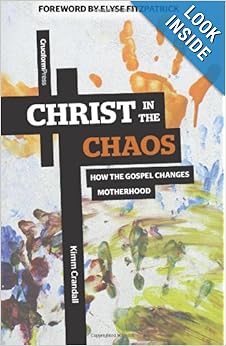
Christ in the Chaos by Kimm Crandall - Best book I've read on motherhood hands down!  This is an honest, no fluff, book that gives moms gospel truths in this calling called motherhood.  She emphasizes the importance of the gospel and how Christ's life, death, and resurrection change every aspect of motherhood.  This book was a great encouragement to me as it exposed my sin and breathed freedom to serve my family knowing that God's love does not change based on my performance!  Love this book!  I have a feeling I'll be rereading this one!


Crazy Love by Francis Chan - I read this over a long period of time on my iPhone at night (free via amazon kindle).  Chan's love for God is contagious as you read this book.  This book calls you to a passionate love relationship with God.  As we encounter God's love we are changed by it!


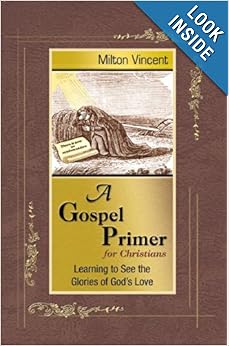
A Gospel Primer for Christians by Milton Vincent - I've read this book several times now with my quiet time and am rereading again now.  Christians need to hear the gospel even after conversion and this book helps you to do that.  There is lots of talk about being gospel-centered today and this book exemplifies that practice.  I love reading this in the morning as it helps me preach the gospel to myself!


The Valley of Vision: A Collection of Puritan Prayers and Devotions  - Like A Gospel Primer I enjoy reading a prayer from this book along with my Bible reading.  The prayers in this are beautiful!  This book encourages the discipline of prayer in my life.


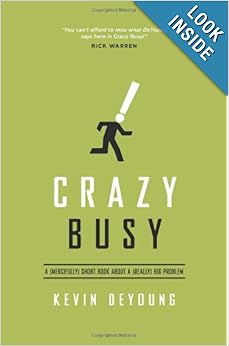
Crazy Busy by Kevin DeYoung - I'm a big fan of Kevin DeYoung and have enjoyed other books by him.  This book address the problem of busyness and we all can identify with.  He digs deep in God's word to get to the source of the issue of our busyness and addresses the heart.  I appreciate the depth yet the practicality of this book.  One that I'm still seeking to apply!


Glimpses of Grace by Gloria Furman - This book was an encouragement to see the reality of God's grace in the all of life (even the most mundane of activities).  This was a gospel-centered book and spurs me to experience the gospel in my everyday....especially when the mundane tasks get monotonous.